

Payment webhooks
Headers and payload samples for payment status notifications.
Refund webhooks
Payload samples for refund status notifications.
Settlement webhooks
Settlement status notifications and payout objects.
Subscription webhooks
Subscription lifecycle and payment status notifications for recurring billing.
Payment Link webhooks
Payload samples for payment link status notifications.
Payment Form webhooks
Payment status notifications for no-code payment forms.
Card token webhooks
Instrument payloads for saved card token status notifications.
Dispute webhooks
Chargeback and dispute status notifications.
SoftPOS webhooks
Terminal and SoftPOS transaction status notifications.
Easy Split webhooks
Vendor settlement and vendor status change notifications for Easy Split.
Global collections partner webhooks
Partner-facing notifications for international collections transactions.
Verify webhooks
Verify webhooks to prevent tampering and ensure you process only legitimate notifications from Cashfree. Without verification, your application is vulnerable to fraudulent payment confirmations and security threats. Use webhook signatures to authenticate Cashfree webhooks, and proceed with further actions only after successful verification.Test webhooks
Before going live, test your webhooks in the sandbox environment to verify payloads and integration behaviour. Configure your webhooks from the dashboard in the test environment. Events triggered by test transactions send webhooks to your configured endpoint.You can create endpoint URLs and test webhooks using tools like
webhook.site or create a tunnel to your localhost
using tools like ngrok.
Duplicate webhook processing
Cashfree uses at-least-once delivery to prevent missed webhook
notifications.
To prevent business processing of duplicate events at your end, you are strongly recommended to validate
x-idempotency-header in each webhook header. This hashed
value will always be unique for each unique webhook payload.
This feature is available on webhook versions starting 2025-01-01. To migrate
to this new version, refer to Webhook Migration section
below.
Retry webhooks policy
You can define a custom retry policy for webhooks that do not receive a 200 response. To configure the retry policy, log in to the Merchant Dashboard and go to Payment Gateway > Developers > Webhooks. Cashfree retries delivery to your URLs based on the defined policy until it receives a 200 response. You will see two types of URLs listed -NOTIFY_URL- This is the default configuration added to your account and configurations here cannot be edited or deleted. This configuration will apply to only the URLs sent in the notify_url param of Create Order API within the order_meta object- Your custom configured URLs - You can click on ‘Edit’ and follow the steps on the screen to define a custom retry policy. A default policy is applied to all URLs
- Default: The system retries up to three times at 2, 10, and 30-minute intervals.
- Fixed: You can specify the number of retries (maximum of 10) and the interval between retries.
- Exponential: You can specify the number of retries (maximum of 10), the interval, and a multiplier. For example, if the number of retries is 5, the interval is 15 minutes, and the multiplier is 2, retries occur at 15, 17, 19, 23, and 31-minute intervals.
- Custom: You can specify the number of retries (maximum of 10) and define custom intervals.
Resend webhooks
This feature is only available for
payment
webhooks- Go to Webhooks under the Developer section and go to Logs.
- On the top right, click the Batch Resend button.
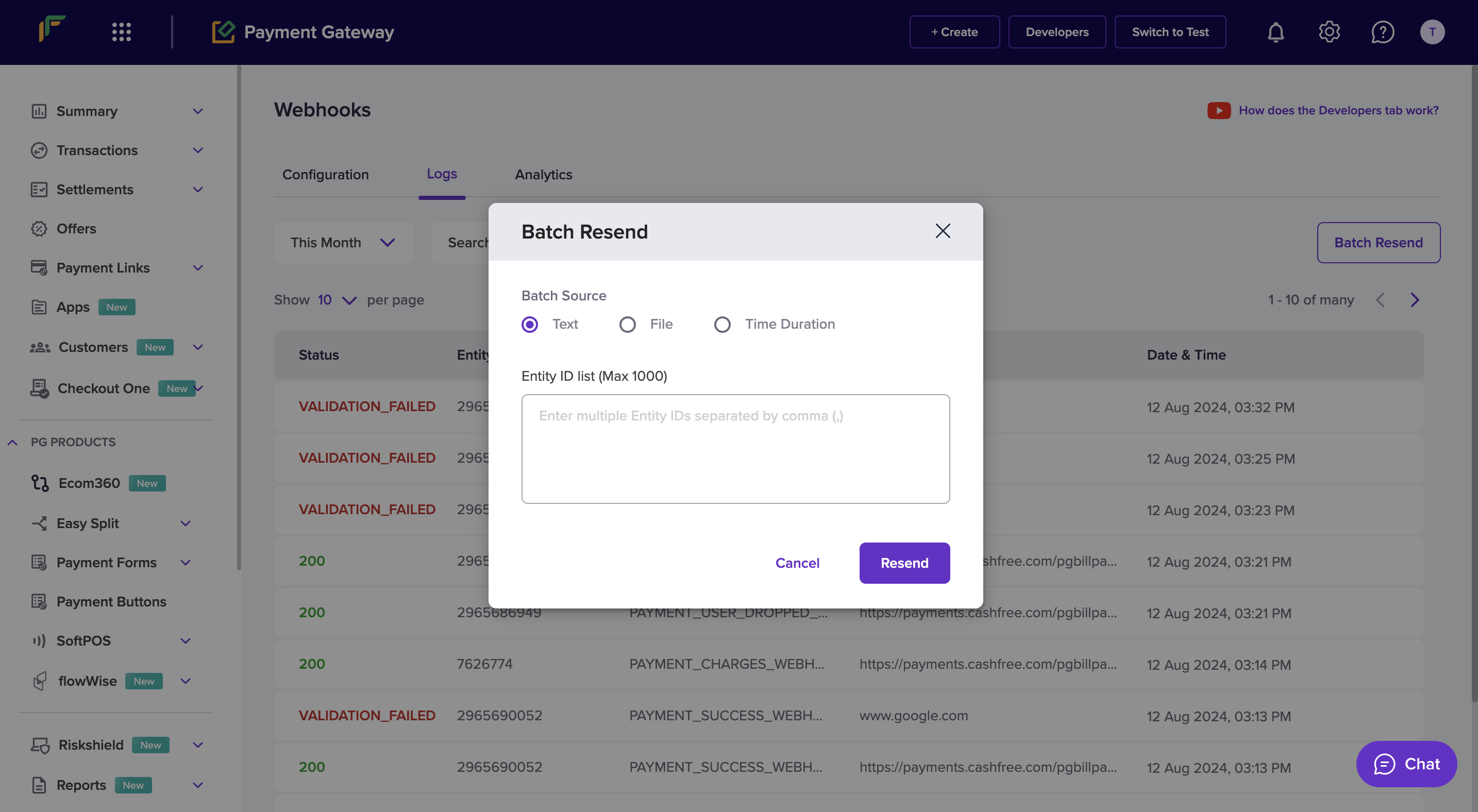
- You will see three options here:
- Text: Enter transaction IDs (comma separated) in the text box and click Resend. Transaction IDs are the same as Entity IDs listed on the logs dashboard.
- File: Upload the file in the required format (downloadable from the dashboard) with the required Transaction IDs and click Resend.
- Time Duration: Select the time period (max. allowed duration is 24 hours) and click Resend.
Webhook signature verification
Use the signature to verify that the request has not been tampered with. To verify the signature, you need your Cashfree PG secret key and the payload.- The timestamp is present in the header
x-webhook-timestamp. - The actual signature is present in the header
x-webhook-signature.
signature-verification
SDK verification (built-in approach)
Manual verification (custom approach)
Webhook migration
Webhook endpoints have a specific API version set, for example,2023-08-01. To migrate from an older version to a newer version, follow these steps:
1
Add webhook for new version
Create a new webhook endpoint with the new URL and new version. Subscribe to
the events you want to consume.
2
Update your code to return 200 for new webhooks
Update your event processing code and return a 200 response to prevent
delivery retries. Next, enable the new webhook endpoint that you created in
the previous step. At this point, every event is sent twice: once with the
old API version and once with the new one.
3
Update your webhook code to process events for the new endpoint
Update your code to ensure you can process the version of your new webhook
endpoint. Make sure you read the changelog and handle any breaking changes.
4
Disable old webhook endpoint
If events aren’t being correctly handled by your new code, first temporarily
disable the new webhook endpoint. After monitoring for some time, you can
permanently delete the old webhook endpoint.