

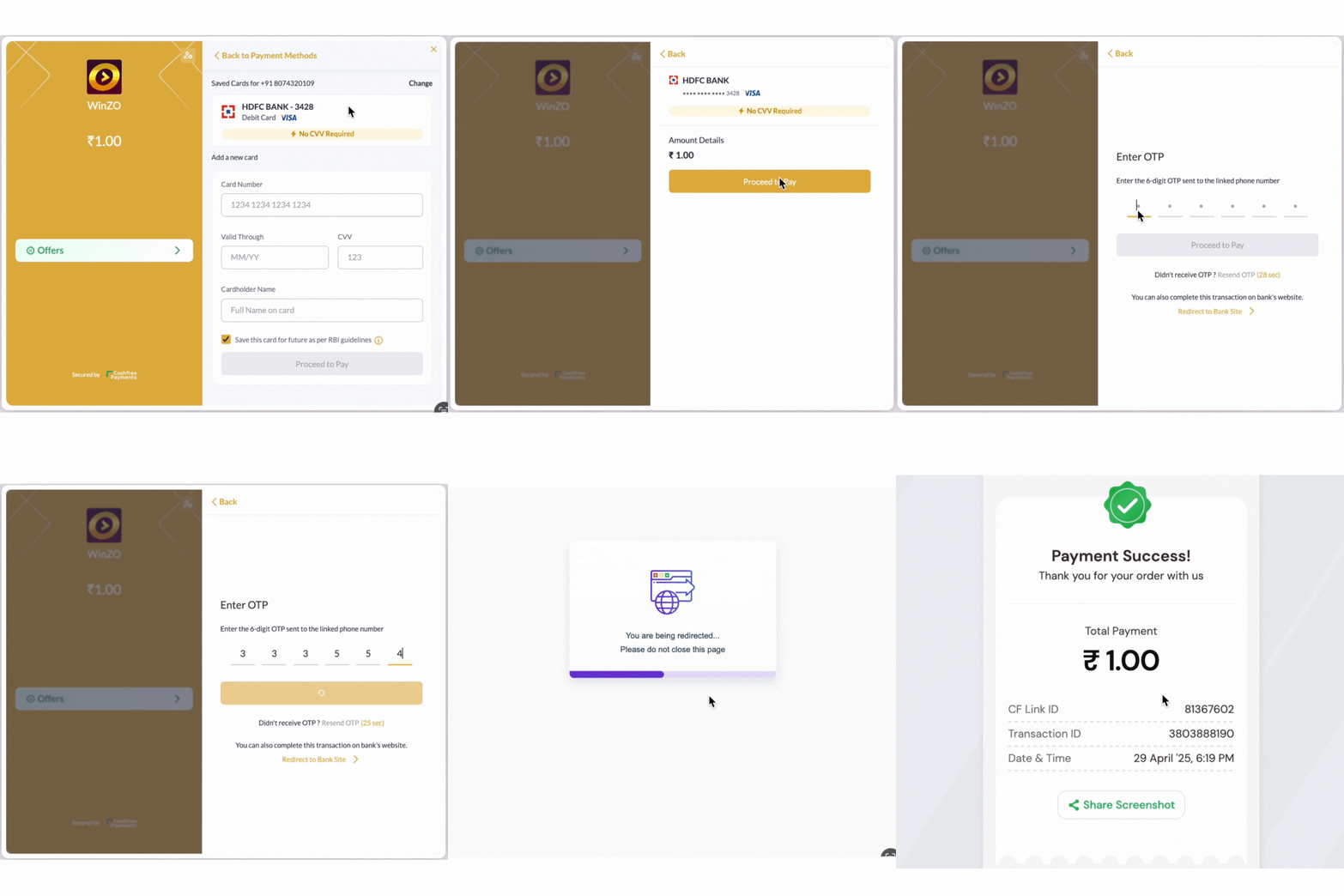
CVV-less experience on Cashfree Checkout
Benefits and security considerations
- Broader network support: Available across Visa, Mastercard, Amex, RuPay, and Diners networks.
- Higher conversion and success rates: CVV-less payments for tokenised cards typically improve success rates by approximately 5%.
- Enabled from day 0: Enabled by default across all networks for tokenised cards from day 0.
-
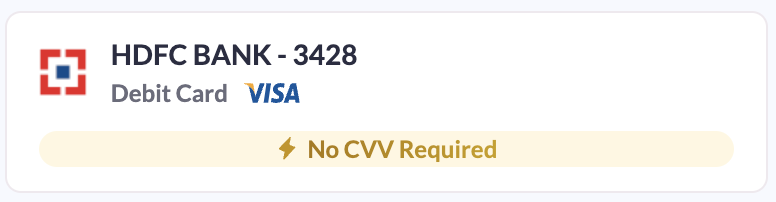
CVV-less indicator: Saved cards display a No CVV Required label during checkout on the Cashfree Checkout.
- Faster checkout and reduced friction: Customers do not need to remember or enter CVV details for saved cards.
- Secure and compliant: Transactions are protected by tokenisation, OTP validation, 3D Secure authentication, and real-time risk checks. Fully compliant with PCI DSS, RBI regulations, and card network guidelines.
Using CVV-less payments with Cashfree payment gateway
CVV-less payments integrate seamlessly with Cashfree’s infrastructure. Depending on your integration method, minimal changes may be required.For merchants on seamless API integration
For saved card transactions across supported networks, thecard_cvv field is optional by default. To enable CVV-less payments, exclude this field from your payment request.
Sample Order Pay API request
- For tokenised cards on Visa, Mastercard, Amex, RuPay, and Diners, remove the
card_cvvfield from the card object.
CVV input is optional only for tokenised card transactions (transactions using saved cards). For plain card or guest checkout transactions, CVV input is mandatory.
For merchants using Cashfree checkout UI
Cashfree enables CVV-less payments by default for all saved card transactions across supported networks. You don’t need to configure anything additionally.Frequently asked questions
What is a CVV-less card payment?
What is a CVV-less card payment?
A CVV-less card payment allows customers to complete a card transaction without entering the Card Verification Value (CVV)—a 3- or 4-digit security code typically required at checkout.
How is the transaction secured without CVV?
How is the transaction secured without CVV?
CVV-less transactions maintain security through 3D Secure (3DS), OTP (One-Time Password) authentication, secure encryption of card data, and additional risk checks such as real-time fraud detection.
Are CVV-less payments compliant with regulatory guidelines (like RBI or PCI DSS)?
Are CVV-less payments compliant with regulatory guidelines (like RBI or PCI DSS)?
Yes. CVV-less payments are compliant as long as they involve tokenised cards and adhere to the card network and RBI guidelines for authentication.
Why should a merchant allow CVV-less payments?
Why should a merchant allow CVV-less payments?
CVV-less payments reduce friction at checkout, improving conversion rates and enhancing customer experience, especially for a returning user base in mobile-first markets.
What are the pre-requisites for CVV-less payments?
What are the pre-requisites for CVV-less payments?
CVV-less card payment experience is available only for tokenised cards, meaning the card is securely saved with a merchant.
Will offering CVV-less payments increase my payment success rates?
Will offering CVV-less payments increase my payment success rates?
Yes, the CVV-less card payment feature improves success rates by approximately 5% on average.
Which card networks support CVV-less payments?
Which card networks support CVV-less payments?
CVV-less flow supports tokenized payments on Visa, Mastercard, RuPay, Amex, and Diners.
Is CVV-less payment possible via Payment Links and Payment Forms?
Is CVV-less payment possible via Payment Links and Payment Forms?
Yes. Both Payment Links (PL) and Payment Forms (PF) support CVV-less payments.
Is CVV-less by default enabled?
Is CVV-less by default enabled?
Yes. From day 0, merchants can enable CVV-less payments for their customers (only on tokenised cards).